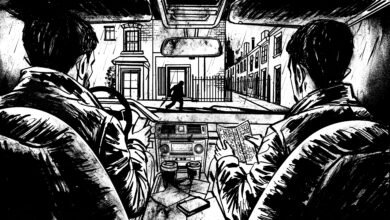

Preparing to set out on a long car journey, naivety tends to get the best of us. “Google Maps says it’ll take eight hours, but I’m pretty sure I can make it in six.” We plan, and God laughs. Pull over to use the bathroom, switch between speed limits, and wait for an inevitable bout of traffic to slow the car’s pace to a crawl for who knows how long. Whether we planned for them or not, the road is filled with obstacles, detours and dead ends. Eventually, the novelty of the road trip fades, and hope subsides. The car is home until proven otherwise.
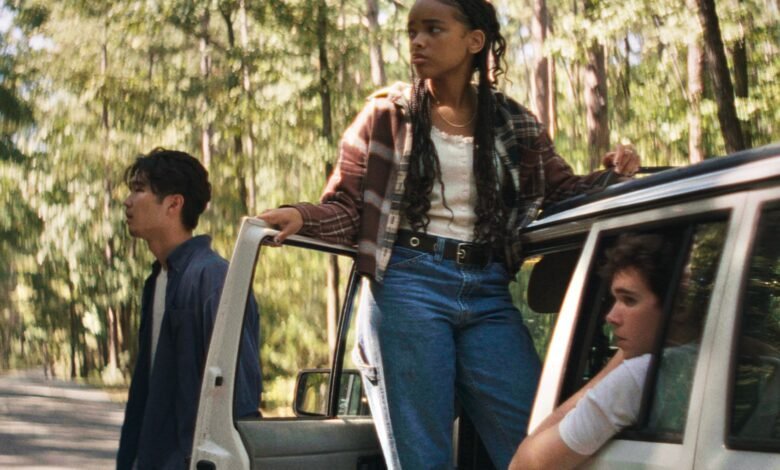
“It Ends,” the bold and breathtaking feature debut from writer-director Alexander Ullom, travels a similar trajectory, both in the context of the film itself and its intrepid journey to the big screen. The movie follows four friends in their early 20s — Day (Akira Jackson), James (Phinehas Yoon), Tyler (Mitchell Cole) and Fisher (Noah Toth) — who pile into a car for one last group hang before real life starts. On the way to their destination, they turn onto a two-lane road that seems to stretch on forever, with the way they came now blocked by dense forest. What’s more, every time they exit the car for more than 90 seconds, they’re swarmed by screaming-mad people who emerge from the woods, begging for help. The group’s only solution is to keep driving, hoping that the road will eventually end.
(Neon) Akira Jackson and Noah Toth in “It Ends”
In the case of “It Ends,” the unconventional path to the silver screen is especially impressive. While those seeking an entertaining thriller will no doubt be pleased by the movie’s swift 89-minute runtime and purposeful plotting, audiences wanting — maybe even aching for — true profundity will find delight in peeling back the layers.
When It Ends premiered at the South
When “It Ends” premiered at the South by Southwest Film Festival in March 2025, it was not exactly the runaway darling of the year’s programming. Early critics took a shine to the film, but many reviews were laser-focused on the movie’s ideas about the difficult yet ultimately benign transition into adulthood. And, to be fair, that is a major aspect of Ullom’s narrative. But stopping there would merely graze the surface of all the blistering insight “It Ends” offers about the way we live now — fascinating, gutsy observations that make up the core of Ullom’s characters and their bleak reality. For a film as thoughtful as this one, further introspection is not only deserved, but wildly rewarding.
But for anyone to dive deeper, the movie first had to get people’s eyes. That’s a task far easier said than done for a microbudget indie like this. A festival slot does not guarantee that a movie will ever see the light of day with mainstream audiences, let alone get the wide theatrical release that “It Ends” is enjoying now. But much like its characters, faced with unimaginable hurdles in a world stacked against them, Ullom’s film found a way to keep going, aided by uniquely modern tools and a singular perspective. And as it bookends a summer led by “Obsession” and “Backrooms” fervor, with studios clamoring to find the next Gen Z wunderkind, Ullom quietly but consistently surpasses his peers at every winding turn. If the future of filmmaking really is in the hands of those who can best define this dreary period of life, “It Ends” meets that challenge with an optimistic, tenacious flair movies have been missing.
Unlike “Backrooms” and “Obsession,” which came with built-in audiences courtesy of their directors’ years honing their craft (to varying degrees) on YouTube, “It Ends” arrives with little to no inherent fanfare. Ullom has a few silly sketches on YouTube, and even scored a partial investment from a subscriber, but he hasn’t posted on the platform in more than five years.
I’d wager that’s a large part of why
I’d wager that’s a large part of why “It Ends” feels blessedly removed from the hype of internet media, yet still very much in conversation with the fixations and lifestyles of Gen Z audiences. Ullom doesn’t have to worry about catering to existing fans of his work. He’s working from a relatively clean slate, and experiencing all of the privileges and drawbacks that come with it.
Distribution has been both the film’s biggest snag and the source of its distinctiveness. After the SXSW hype died down, “It Ends” sought distribution for most of 2025 until Letterboxd announced that the film would be a launch title in its new Letterboxd Video Store, created to showcase emerging talent and festival first-runs without a distributor. Beginning last December, “It Ends” was made available for one month in the Letterboxd Video Store for a small rental fee. And within a week of Letterboxd users excitedly logging and loving it, NEON acquired “It Ends” for theatrical distribution. Within a year and a half, Ullom’s tiny indie film went from its festival debut to a wide theatrical release, backed by the company behind some of cinema’s most awarded and talked-about films.
Want more from culture than just the latest trend? The Swell highlights art made to last.
Sign up here
Stories like this are cropping up more frequently
Stories like this are cropping up more frequently now that major studios are coming to understand that viewers want original stories from new voices. But in the case of “It Ends,” the unconventional path to the silver screen is especially impressive. While those seeking an entertaining thriller will no doubt be pleased by the movie’s swift 89-minute runtime and purposeful plotting, audiences wanting — maybe even aching for — true profundity will find delight in peeling back the layers.
I feel as though I’ve spent much of my summer taking shots at “Obsession” gussying up its thin characterizations to fool people into thinking it’s anything more than your standard horror sludge. And I wasn’t entirely thrilled with “Backrooms” getting lost in the maze of its metaphors, either. But the further I traveled with the crew at the heart of “It Ends,” the more blown away I was by the deceptively, ahem, straightforward themes Ullom chips away at. Here is a writer and director with not just plenty on his mind, but the preternatural proficiency to execute those ideas in haunting, humorous and really quite moving ways.
Although I didn’t expect that would be the result, judging from the movie’s introduction, in which the quartet pile into a Jeep Cherokee and spend the next 15 minutes running through Gen Z twitterspeak at the pace of a Subway Surfers game level. But as things get going, it becomes painfully clear that’s Ullom’s point. Digital disaffection has bled into our lives like dye onto white linen, creeping through every inch of the fabric until it’s covered in amorphous patterns of color; some beautiful, some painfully ugly. The internet has made it far easier to bond with our friends through memes and slang than through genuine vulnerability. Day, Tyler, James and Fisher pretend nothing matters until an inexplicable cosmic force throws them into a situation where that becomes a reality. Suddenly, everything matters. And with that veil ripped off, every emotion they didn’t let themselves feel, every word left unsaid, every last regret, all become instantly magnified, sprawling out before them on an endless road.
That we see the group start scared
That we see the group start scared for their lives, and then watch as they embrace their place in the infinite agony to the point that it becomes comical, is remarkable. The more we accept that anguish is a basic part of life, the less we care. And when we stop caring, we give up hope, abandon the journey and walk off into the cold, dark woods alone.
Writing the rules of this unexplained, Sartre-esque reality the group has found themselves in, Ullom wisely allows some things to remain unchanged. The car never runs out of gas. Cellphones still work. Sleep and food are no longer necessary. These strange laws of existence provide the framework for Ullom’s excellent social observations, zeroing in on each character’s relationship to this new world and comparing it to the old one. Once the fear wears off and the road becomes home, the group develops its own rituals and routines, but maintains its connection to what came before all this, however fleeting it may be. At one point, Fisher scrolls through his phone and laments that he has only a few pictures of his family in his meme-filled camera roll; intimate human memories — the things that make us people — outnumbered by heaps of digital ephemera. Laughter is momentary, but love is forever. There has to be space in this life for both, but somewhere along the way, connection was devalued, replaced by a deep-fried image of the GEICO gecko.
Our Summer sale ends August 31!
Premium members read ad-free and save 58%. Join now
(Neon) Akira Jackson in “It Ends”
The film’s richest, most affecting moment is also one of its funniest. Some time into their ceaseless road trip, the threat of the people in the woods dulls. Their terror is no longer the group’s terror. When Day and Fisher stop for a 90-second break to practice a dance they’ve been working on, they hear a voice scream out for help from the forest. Scoffing, Day mimics the cry: “Help meeee!” It’s humorous in the moment, but it’s also a succinct, pointed metaphor for the rapid desensitization we’ve all experienced through the internet.
After so long on the road, driving past
After so long on the road, driving past despair dotted along the road’s shoulders, Day brushes off a cry for help with a joke. The response is eerily familiar. We witness so much suffering daily — people displaced from their homes, shot dead in the streets, having their land colonized and bombed in useless wars, struggling to feed their families and find work; you name it — that, eventually, the pain becomes fodder. It’s misery as white noise. That we see the group start horrified and scared for their lives, and then watch as they embrace their place in the infinite agony to the point that it becomes comical, is remarkable. The more we accept that anguish is a basic part of life, the less we care. And when we stop caring, we give up hope, abandon the journey and walk off into the cold, dark woods alone.
Perhaps there is no way to stop this suffering. Ullom is courageous enough to ask this question and so many more with total honesty. But he does stress that the smallest seed of hope is what allows us to maintain our humanity, compassion and desire for companionship, even in the most dire straits. You might say that’s mawkish, or that I’m grading on a curve for a first-time filmmaker. But I’m blown away by how “It Ends” reaches into the abyss of contemporary living and pulls out something tangible for us to chew on. That something so bold can have the journey this film has had is even more heartening. Taken together, we see hope and its absence wedged in the backseat. It takes courage to hold onto it, and a different kind of courage to give up. But either way, there’s no braving this journey alone.
about films that will sneak up on you
- “A Private Life” is Jodie Foster’s moving French masterpiece
- With “The Shrouds,” cinema’s great body horror auteur goes for something a little lighter: grief
- “Seven Veils” is the latest film to reconsider how much value we put into an artist’s pain
The post “It Ends” beat Hollywood at its own game to reach theaters appeared first on Salon.com.
Source: www.salon.com